Well, after far too many delays, progress is coming to the cabin again. I was able to get a few more projects completed and some additional ones started.
To begin with, my wife insisted on a shower. And remember we do not have electricity, a well, running water, septic or anything. It is completely off the grid. After much research and planning. The decision was made to build a solar - gravity feed shower. This is a really easy project as it turned out and it seems to be working very well.
First was the platform, I needed to build a strong platform that could hold a fifty gallon drum full of water. Or about 450-500 lbs. Treated 2x4 was the answer, and a lot of strong bracing. Its a simple structure that is anchored into the ground with four 24" pieces of rebar with a nut or washer welded to the top.
The construction of the actual shower was simple. The barrel was washed thoroughly, all though all it had in it for years was dog food. We cleaned it with soap and water and rinsed thoroughly. A 5/8" hole was drilled three inches from the bottom. A piece of 3/4" threaded PVC coupling was threaded into the hold using Teflon tape and plumbers putty for good measure. From this a short piece of 3/4" pvc, a ball valve, another short piece and a shower head. This is supported with a small 1/2"x 4" support.
Open the ball valve and water flows, close it and your done.
I am still in the testing phase, so I am not sure how long it will take the sun to heat the black barrel and fifty gallons of water. The plan is to fill it before I leave so it is warming while I am away, and will be ready upon arrival. Although to help, I opted for a black barrel to retain more heat. And filling is done now with buckets. The final version will tap into my 12 volt system and we will connect a bilge pump from a boat to take water from the rain barrels to the shower barrel.
Tuesday, May 6, 2014
Saturday, March 8, 2014
What Makes Accuracy
There are a lot of factors that make shooting archery efficient. Accuracy is paramount when shooting or hunting. Nothing bothers hunters more than missed shots. Tournament archers have many sleepless nights over one bad shot. But there are ways to improve accuracy, and ways to make your shooting more consistent. Here are some things you can try to make your shooting so accurate you will have full confidence when you step to the line, or draw on that buck that the arrow will hit exactly where you intend.
1. Get the best bow you can afford.
2. Quality Arrows
I am always amazed at the number of people shooting thousand dollar bows and $2.00 arrows. The bow can only shoot as accurate as the arrow will fly. When it comes to arrows for accuracy nothing beats carbon. Aluminum is as archaic as stone points. Leave it behind, buy the carbon. The three brands to consider for accuracy, Easton (including Beaman), Carbon Express, and Gold Tip. But when you want to really compete and want the most confidence you can have in your arrow, Gold Tip stands heads and shoulders above the rest. Their target arrows are so precise and accurate you cannot shoot at the same spot because you will have too many "Robin hood" shots destroying arrows. Personally I shoot the Pro Series 22 by Gold Tip for tournaments. it's a medium diameter shaft and with the Gold Tip FACT system I can balance the arrow to the gram giving me precise balance arrow to arrow. This is similar to hunters who reload their ammo to get accurate consistency between shots. Gold Tip gives you this option. (www.goldtip.com)
3. Stabilization
Target archers understand the importance of good stabilizer for their equipment, this has not yet made it way into the hunting industry. Hunters use short heavy stabilizers that really do little more than add weight to the bow. But to achieve true stabilization you need a system similar to target archers. Granted a 36" stabilizer isn't practical for hunting situations, but neither is a 5" stabilizer doing you any good at all. Fortunately Bee Stinger has come up with the best solution to accommodate the hunter. (www.beestinger.com)
Think about it, do you want the shot of your life to hinge on your ability to hold steady with your heart pounding, gasping for breath? Or would you rather have your bow fall into its normal location because of great stabilization? The Bee Stinger Sport Hunter Xtreme Kit allows hunters to get the same benefit of tournament archers. The front bar and back bar allow for almost instant alignment to your target. Do not hunt or shoot without great stabilization.
4. Release aids
There is a lot of discussion when it comes to release aids. Caliper, thumb release, back tension, etc. It really comes to preference. Personally, I really like the wrist strap finger release caliper system. It works for me. But learning the system and getting a good feel for the system is critical to getting good accurate shots.
5. Good and Efficient Practice
You cannot shoot well, if you do not practice. And by practice, I mean not just shooting a few arrows before season, or the day before a tournament. I mean a lot of practice. Case in point, I am currently training for a couple of 900 rounds coming up in a few weeks. One is a state shoot and the other is part of the South Carolina Senior Sports Classic. To get ready for these, I am shooting between 50 and 150 arrows a day. Every day - These tournaments consist of 90 arrows shot in a specific time frame. Fatigue will be the issue for many who have not practiced. By shooting over 100 arrows a day every day - my muscles will be in shape for the tournaments. Plus I am shooting every tournament I can between now and then. Every 3D tournament, the Rinehart 100, all of them.
This practice will completely translate into the hunting world when I head to Colorado in September for Elk, or when I climb a tree in October and that buck walks out.
I recently incorporated a new step in practice, that is getting my heart rate up, to shoot one arrow. By walking fast or jogging over a 50 yard area, grabbing my bow and making one 60 yard shot. This forces me to get everything under control and making that one great shot.
In summary, even the average archer can achieve top level accuracy with excellent equipment and great practice. Similar to top gun shooters who purchase top scopes, best brand rifles and hand load their ammo. Archers who want to compete and feel confidence in the stand can do so by following these simple steps.
Thursday, March 6, 2014
The PRIME Alloy
Last week I received a new bow. The all new PRIME Alloy. (www.g5prime.com)
I have been a PRIME shooter for just over a year now, and I have always been very impressed with the product. But the Alloy is on a completely different level.
To provide some background; I have been bow hunting since the late 1970's and shooting ever since. I jumped onto the 3D bandwagon in the 1990's and shot for quite some time. Achieving mediocrity at best. After a long sabbatical from the competition circuit I began shooting again a few years ago to stay sharp. While it may seem simplistic to readers, the old saying is so true, "you are only as good as your equipment will allow." Nothing could be more true.
Since shooting the PRIME Alloy and Gold Tip Arrows, I have been able to achieve scores I thought were only reserved for professional shooters. While I am sure I will never be able to compete with to top shooters, (my eyes are just too bad to see the details of the higher scoring rings) I have been able to achieve scores I never imagined. While I know the amount of work I am putting into practice has a lot to do with it, there is no doubt that the equipment has elevated the game exponentially.
I have seen scores increase by more than fifteen points per round. That is a total game changer in the competition world. I have moved from being an "also ran" to a contender and I believe that using the best equipment available has made that move faster than my practice alone could have.
The accuracy of the PRIME Alloy is beyond measure. This bow is incredibly stable, easy to hold, and consistent. After dialing in my G5 Optix XR sight I was shooting insanely tight groups out to 60 yards. I will give more details about the full set up in coming posts. But to say without hesitation the Alloy is the best bow available PERIOD.
If you are currently shooting tournaments or are contemplating it, or if you are a hunter, you owe it to yourself to get the best bow you can afford. Make it the best, make it a PRIME.
Wednesday, March 5, 2014
Delay's - - Delay's - - and More Delay's
As life would have it - things have come to a screeching halt at completing the cabin. Seems that everything else is taking up my time of getting things done. But there is time. One of the great things about this cabin is time is on my side. There is nothing pushing me to get it complete except "wanting to finish".
I did get two more windows installed and they are really looking good. By the time I get the last two in I will have figured out the most efficient method of installing them. While I realize it may sound simplistic, but until you have lived in a cabin with no windows, you cannot fully appreciate the feeling of letting natural light in through glass. It changes the whole mood of the cabin. Transforming the feeling from a "cave" to a real cabin.
Next is the 12 volt lighting system, kitchen cabinets and insulation. Stay tuned.
However in an effort to keep the blog fresh, I will have to deviate from the cabin construction to other elements and come back to it when there are more updates.
I did get two more windows installed and they are really looking good. By the time I get the last two in I will have figured out the most efficient method of installing them. While I realize it may sound simplistic, but until you have lived in a cabin with no windows, you cannot fully appreciate the feeling of letting natural light in through glass. It changes the whole mood of the cabin. Transforming the feeling from a "cave" to a real cabin.
Next is the 12 volt lighting system, kitchen cabinets and insulation. Stay tuned.
However in an effort to keep the blog fresh, I will have to deviate from the cabin construction to other elements and come back to it when there are more updates.
Wednesday, February 19, 2014
Building a Hunt Camp - Phase 6
The Cabin is still waiting for more work. I haven't had the time to get down there and add some more to the construction. This weekend I am heading down to do a bit more. The plan now is to put in a few more windows, if the rain holds off. If not, I will spend the rainy weather installing the 12 volt lighting system.
I will say without shame I am no engineer. The road to 12 volt lighting has been long. But we decided months ago we wanted to be "off the Grid" and to do that we have to be self sufficient. After months of research it appears the best solution is 12 volt LED lighting and other appliances. It seems the RV world has plenty of appliances that are accustomed to running off of 12 volt. As of now I am not intending on using a power inverter to move the power from 12 volt to 110. But that may come if the need arises. Fortunately, there are plenty (as of now) low voltage lighting, fans, refrigerators etc. that will not only function on 12 volt but are designed for 12 volt.
I want to save the details of the install for a future post and include all of the engineering details for those who are interested. Photos will come and show the process.
Windows, 12 volt lighting, insulation who knows - it depends on the weather. So we will see next week what progress has been made.
I will say without shame I am no engineer. The road to 12 volt lighting has been long. But we decided months ago we wanted to be "off the Grid" and to do that we have to be self sufficient. After months of research it appears the best solution is 12 volt LED lighting and other appliances. It seems the RV world has plenty of appliances that are accustomed to running off of 12 volt. As of now I am not intending on using a power inverter to move the power from 12 volt to 110. But that may come if the need arises. Fortunately, there are plenty (as of now) low voltage lighting, fans, refrigerators etc. that will not only function on 12 volt but are designed for 12 volt.
I want to save the details of the install for a future post and include all of the engineering details for those who are interested. Photos will come and show the process.
Windows, 12 volt lighting, insulation who knows - it depends on the weather. So we will see next week what progress has been made.
Monday, February 10, 2014
Building a Hunt Camp Phase 5
It has taken us months to get to this phase. Actually after the concrete was poured we went ahead and set the door. But then hunting season arrived and everything else was put on hold until after hunting season was over. But to this point we have the building sealed and dry. Roof, concrete floor and we started moving in.
I don't have pictures of it, but I used the spray foam sealant to seal the gap all the way around the bottom of the building. There were gaps between the wall tin and the flooring due largely to the shape of the wall tin. So the spray foam worked great at sealing it off. The top - where the corrugated roofing met the top plate left gaps in the shape of the roofing. After a lot of research, we went with the foam insulation used around window unite air conditioners to press into the gaps It was inexpensive and worked well. All of the rest of the gaps will be sealed with spray foam or fiberglass insulation. (gaps too large for spray foam - this is only in the corners around the corner posts) We will cover the rest of the insulation later.
For now we are putting in the door and windows. Or the front windows. So cutting the door was interesting, let me say clearly, when cutting metal siding, ear plugs are a necessity! But the hole was cut and the door installed. (Still needs painting but its too cold to paint it now) And last weekend we installed the two front windows. Having spent the last four months of deer season in a building with no windows, it is very refreshing to have some natural light into the building. The cabin was more like a cave for the season. Needing full lantern power during the day or night! Now with two windows it give great light. We will be putting in four more windows later.
- - to this point we have done all we can. As the budget allows we will be doing the following:
installing four more windows
Installing 12 volt LED lighting through out the building
Building and installing kitchen cabinets
Installing a wood heat stove
Installing a small propane cook stove
Designing and installing water system.
Building our Outhouse
Building our shower house
Building a covered front porch
I don't have pictures of it, but I used the spray foam sealant to seal the gap all the way around the bottom of the building. There were gaps between the wall tin and the flooring due largely to the shape of the wall tin. So the spray foam worked great at sealing it off. The top - where the corrugated roofing met the top plate left gaps in the shape of the roofing. After a lot of research, we went with the foam insulation used around window unite air conditioners to press into the gaps It was inexpensive and worked well. All of the rest of the gaps will be sealed with spray foam or fiberglass insulation. (gaps too large for spray foam - this is only in the corners around the corner posts) We will cover the rest of the insulation later.
| Door before windows installed |
| Front Windows Installed! |
For now we are putting in the door and windows. Or the front windows. So cutting the door was interesting, let me say clearly, when cutting metal siding, ear plugs are a necessity! But the hole was cut and the door installed. (Still needs painting but its too cold to paint it now) And last weekend we installed the two front windows. Having spent the last four months of deer season in a building with no windows, it is very refreshing to have some natural light into the building. The cabin was more like a cave for the season. Needing full lantern power during the day or night! Now with two windows it give great light. We will be putting in four more windows later.
- - to this point we have done all we can. As the budget allows we will be doing the following:
installing four more windows
Installing 12 volt LED lighting through out the building
Building and installing kitchen cabinets
Installing a wood heat stove
Installing a small propane cook stove
Designing and installing water system.
Building our Outhouse
Building our shower house
Building a covered front porch
Thursday, February 6, 2014
Building a Hunt Camp - Phase 4
The roof is on! Now it is time to start on the underpinning and the walls. Since we were using the existing metal from the old garage we tore down, the walls were set to hang. But we decided that we wanted to underpin the flooring to keep out any critters that may want to call this place home. We still have to decide on what type of flooring to put down, wood or concrete. But we will get to that later.
My son came to help me on the underpinning and start on the walls. It was a blast having him along. At 12 years old he worked his tail off. He also helped me set the posts, pour the concrete in the post holes, now he was helping with the underpinning and walls. After all this will be his one day and his ownership in it now will pay huge dividends later.
We opted to use the same galvanized steel we used on the roof as our underpinning. It should last for several decades even in direct contact to the ground plus it just looks good and is more durable than just about anything I could find outside of masonry.
We had to excavate a good bit to get the underpinning where we wanted it, finishing with it level with the top of the floor bands. It really dressed up the cabin better than I originally thought it would.
Then came the walls. The metal sides were hung vertically and simply lapped over one another to get the walls covered. By taking our time we were able to get a lot done each day. We opted to cover over every opening and cut them out later - windows, doors, etc. Plus since we didn't have our floor in place we didn't cut the door opening knowing we would have to have the door flush with the floor. I wanted the floor in place before we cut the door opening.
Next is the door and windows!
| My Son Ridge helping with underpinning |
My son came to help me on the underpinning and start on the walls. It was a blast having him along. At 12 years old he worked his tail off. He also helped me set the posts, pour the concrete in the post holes, now he was helping with the underpinning and walls. After all this will be his one day and his ownership in it now will pay huge dividends later.
| One wall finished! |
We had to excavate a good bit to get the underpinning where we wanted it, finishing with it level with the top of the floor bands. It really dressed up the cabin better than I originally thought it would.
| Back and end finished! |
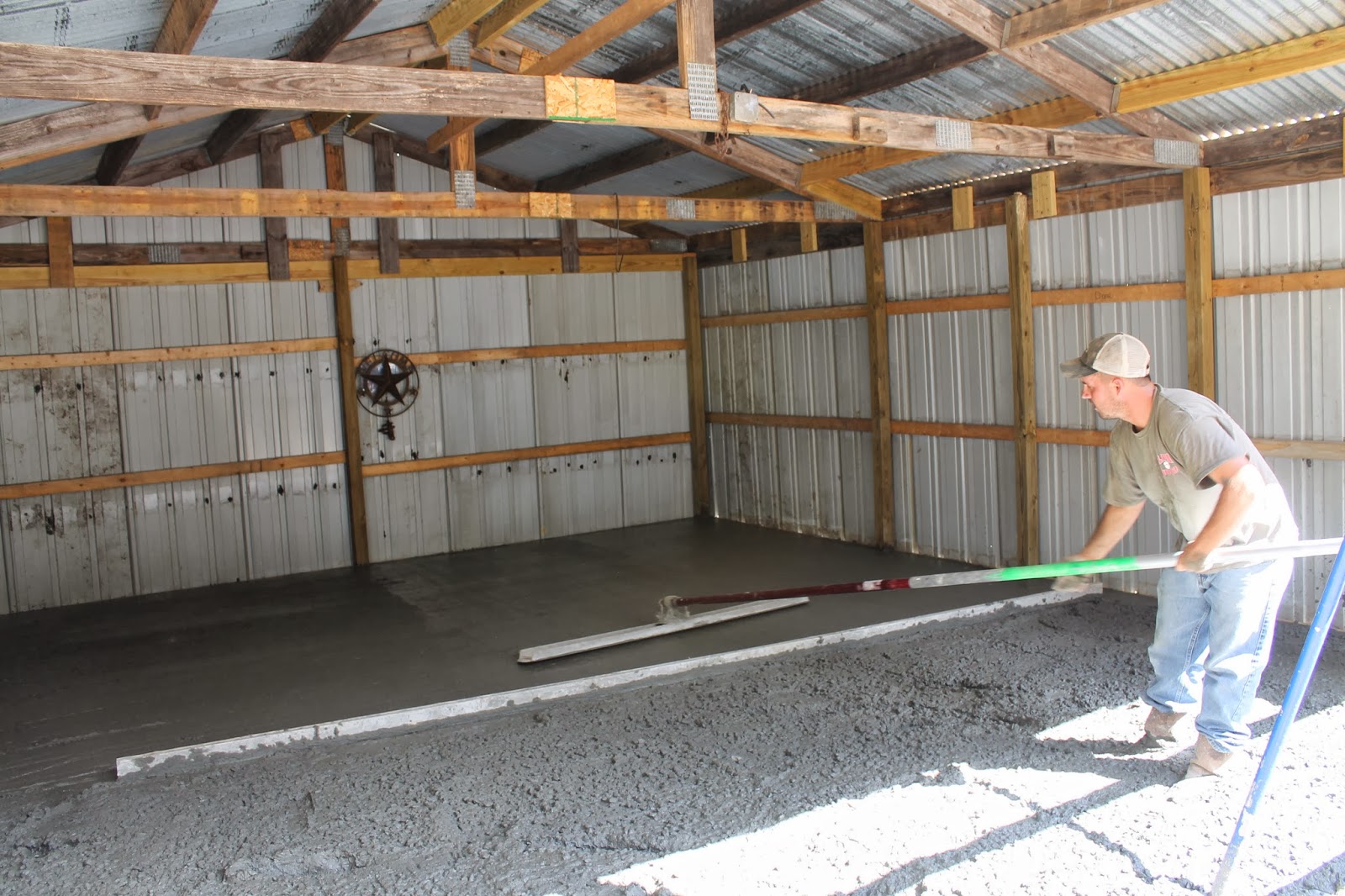
| Pouring Concrete floor |
After a lot of consideration I opted to go with a concrete floor. It did cost a good bit more than the wood floor, but I will never have to worry about replacing anything. Its done. My buddy, David Catoe poured the floor. In half a day, he back-filled the floor, poured and finished it with one helper. amazing how fast he got it done, and I must say it was worth every penny to have it done. I highly recommend any hunt camp built from scratch - get a concrete floor!
| Concrete Floor finished. Great decision to have concrete floor! |
Next is the door and windows!
Tuesday, February 4, 2014
Building Hunt Camp - Phase 3
Now we are ready for the roof. Here there are many options available to choose from. Standard asphalt shingles, roll roofing, tin, galvanized steel, and steel. It really depends on your budget and look you want. I decided after a lot of research to opt for the galvanized steel. Largely because I wanted the look of tin, but wanted to keep it economical also.
After pricing the 5-V tin it was almost $30 per 12 ft piece. While the corrugated galvanized steel was $11 per 12 ft piece. The cost savings enabled me to get a great roof at one third the price of tin, with a similar look. Plus I just like the corrugated look. So we covered the roof with twelve foot pieces of galvanized steel. This roof should last the rest of my life and my son's will have to worry about it before I do. However, before settling on the galvanized steel, I did go look at a lot of older barns that owners wanted torn down to see if I could recycle the roof tin from those barns. Most were OK at best, and after consideration I opted for a new roof.
The new roof went on pretty fast, when you are covering twenty-four square feet with each piece it doesn't take long - However, since we did this last summer, we did have to break it up. When the sun got too high in the sky, it was just too hot to put the roof on with the sun reflecting on our faces. So we started at first light worked for several hours and stopped. Then the last hour of the day we finished.
Once the roof was on we had shade, I pulled out my hammock, strung it between some posts and took a nap enjoying the cool shade we just made.
Next step is underpinning, and starting on the walls.
| Roof finished and nailing boards up |
After pricing the 5-V tin it was almost $30 per 12 ft piece. While the corrugated galvanized steel was $11 per 12 ft piece. The cost savings enabled me to get a great roof at one third the price of tin, with a similar look. Plus I just like the corrugated look. So we covered the roof with twelve foot pieces of galvanized steel. This roof should last the rest of my life and my son's will have to worry about it before I do. However, before settling on the galvanized steel, I did go look at a lot of older barns that owners wanted torn down to see if I could recycle the roof tin from those barns. Most were OK at best, and after consideration I opted for a new roof.
| Roof view from front |
Once the roof was on we had shade, I pulled out my hammock, strung it between some posts and took a nap enjoying the cool shade we just made.
Next step is underpinning, and starting on the walls.
Saturday, February 1, 2014
Building Hunt Camp - Phase 2
As we pick up on the building of your hunt camp, we have the posts set, the concrete is poured around each post and we are ready to put our bands on and set the trusses. We are doing this because we decided it was easier to set trusses and put the roof on before the walls were in our way.
It's important at this point to state that this cabin is completely off the Grid. No electricity, No running water, not indoor plumbing. We will deal with these with some unique designs to be explained later. Now to the construction.
So using 2x6 we placed a band all the way around the bottom and the top. Here it is critical to set grade. Meaning to put the bottom band exactly where you want your floor to be in relation to the ground. My brother used a transit to shoot grade and we marked everything to get the elevation perfectly level. From there we measured up and set the top band to ensure everything was level, plumb and at grade. (Here is where I found my mistake of being a shade out of square)
Once all of the bands were in place (We used 3" deck screws to secure the bands to the posts) it was time to set the trusses. I would highly recommend a minimum of three people to set the trusses, with four or five being even better. Each truss was set directly on top of a post for added support. The trusses were plumbed and secured with support bracing to the walls, and to one another.
After the trusses are in place and secured now it time for the roof joists. In our building we opted to place the joists between the trusses rather than on top of them. Largely because this is how it was when we tore it down and we were using a lot of the original roof joists. Using joist hangers we placed the joists at two foot on center intervals between each truss. Once all of this was done we were ready for the roof.
Point we did all of this in one day.
It's important at this point to state that this cabin is completely off the Grid. No electricity, No running water, not indoor plumbing. We will deal with these with some unique designs to be explained later. Now to the construction.
| Top and Bottom bands in place getting ready for Trusses |
Once all of the bands were in place (We used 3" deck screws to secure the bands to the posts) it was time to set the trusses. I would highly recommend a minimum of three people to set the trusses, with four or five being even better. Each truss was set directly on top of a post for added support. The trusses were plumbed and secured with support bracing to the walls, and to one another.
| End trusses set! |
After the trusses are in place and secured now it time for the roof joists. In our building we opted to place the joists between the trusses rather than on top of them. Largely because this is how it was when we tore it down and we were using a lot of the original roof joists. Using joist hangers we placed the joists at two foot on center intervals between each truss. Once all of this was done we were ready for the roof.
| Trusses and Joists complete ready for roofing |
Point we did all of this in one day.
Thursday, January 30, 2014
Building Hunt Camp - The Beginning
Building a place to call hunt camp means many things to many people. It is both geographical and generational. Southern hunters often gather in old farm houses or barns and convert them into a "hunt cabin". Some utilize older mobile homes or campers and circle the wagons in some configuration at a designated location for their camp.
| Ridge proud of his work setting poles on out cabin |
I opted for something different. My land was barren of old farm buildings so that option was out, and being somewhat frugal (some of my friends would say cheap) I wanted to build a nice cabin as inexpensively as possible. Thus we have in progress the re-purposed or scavenged cabin. Over the next couple of weeks I will cover the step by step process of building this cabin. In cast some of you are looking for a great off season project, this one will fit the bill.
| Ridge pouring concrete around poles |
Interestingly enough it was fairly simple, scouring through want ads and craigslist I searched for old buildings that people wanted torn down. Before I found one, my brother happened upon one that the owner said we could have if we tore it down. So we gathered and began dismantling the old metal garage and transported it to my land for reconstruction.
The best part of building a cabin is you can design it however you like. The garage we dismantled was 20x30 with a 10 ft section closed in and the remainder open bays. After some consideration we built the current cabin 20x24 with it completely closed in. The width was fixed due to the length of the trusses, simple math showed how big we could build the cabin using the existing metal to cover the entire building.
The re-purposed garage come with the metal sides, 4 trusses, one metal man door, and the nailing strips and posts. When we began reconstruction I replaced all posts with new treated posts and sifted through the nailing strips (2x6) and replaced the ones that needed to be replaced. Then construction began on my re-purposed pole building/hunting cabin
Step one: Layout - this part is so critical i cannot stress it enough - I say that because I made a mistake and it has proven costly in effort and expense. Make sure when you layout your building it is completely square (Actually it can be a rectangle but it needs to be equal in all measurements) believe me one half inch can make things very difficult.
Step two: Setting posts - Here you need to make sure the posts are set perfectly plumb and at a sufficient depth. (I hesitate to say how deep because it can depend on your soil quality - plus I do not want to be liable) Pour concrete around each post and let set. Sufficient bracing is needed to hold the posts plumb during the concrete setting process. I would allow the posts to set several days before continuing.
Next we will pick up at putting the bands in place and setting your trusses.
Wednesday, January 22, 2014
What's Your Dream Hunt
As a hunter
I am often asked by fellow hunters and non hunters a question. It’s the one I have
heard hundreds of times and if you are like me, you have heard it too. If you
have ever sat around a campfire, or stared into the sparking night sky, the
question has been asked. If you have ever been drawn into conversation about
hunting with non-hunters you have been asked directly. What is your dream hunt?
The question
lunges into our mind as we spit our verses of animals on far away continents
that we want to chase. Stanzas of species and locations roll from our tongues
as we recite a chorus of adventures we long for. There are species whose heads
we would like to grace our trophy rooms, or whose hides we want covering our
floors. We discuss length of horn, size of skull, beards, spurs, and leg bands.
I have heard them all, or at least close to them all. Leopards in Namibia,
elephants in Botswana, doves in Argentina, Red Stag in New Zealand, Grizzly
bear in Alaska you name it and there are some who want to hunt these marvelous
animals. As long as there have been hunters there have been dreams of hunts to
come.
Perhaps you
too have been asked this question and you conjure dreams of the Dark Continent
or 180” whitetail bucks. Flashes of skies filled with waterfowl of every
species. There are thoughts of bugling bulls, gobbling turkeys, and thundering
herds. Shots that are true and adventures achieved. If you are like me, you
have spent hours perusing the internet looking for opportunities. Back country
elk in Montana, pronghorn in Wyoming, Impala in South Africa, the list is never
ending and is as diverse as hunters themselves.
Recently I had
this question asked of me again, and it occurred to me, that while I would love
to go to Africa and hunt plains game or New Zealand for Red stag, I dream of
chasing big grizzly bears in the Alaskan tundra. The reality is that my dream
hunt is – the next one.
Whether it’s
chasing squirrels through oak ridge’s, or bow hunting whitetails in a hardwood
bottom. The thrill of the hunt isn’t defined by the quarry rather by the experience.
Memories made, moments cherished. I have hunted many different species in
several states and one thing is constant, whether it’s after moose in Alaska or
feral pigs in my native South Carolina, the thrill of being there is equal.
Hunters know that while taking game is part of what we do, it is only a part.
The real thrill comes with the experience. So the next time I am in a
conversation about hunts, places and species, and I am asked what my dream
hunts is, I will look simply and honestly and say, “The next one.” What’s yours?
Friday, January 17, 2014
The Day's Finally Here
This hunt was
a little over thirteen years in the making. To the casual observer, it would
seem pretty uneventful and nonchalant. But for me, it was a difficult day that
took over a decade to achieve.
There were
many occasions when I thought about it. Many opportunities to take it down and
carry it afield but it just never felt right. I resolved that when the time was
right to take it afield I would know, and then I would honor him and the moment
appropriately.
The day
arrived shortly after Christmas. My youngest son received his first shotgun for
Christmas. A hunt was planned to take his first gun on a squirrel hunt, I knew
instantly that this was the occasion I had been waiting for. While it was a
pretty uneventful day, as hunting goes, the emotions of the day ran as deep as
a river carving through an ancient canyon, I knew it was time.
In the
predawn light we walked, cradling our guns like a new father holds his first child.
A rush of memories flooded my brain as we plodded to our destination. My mind
hastily sprinted back to the sights, sounds and smells of our last dove hunt
together. I could smell the tobacco that penetrated the faded dukbax vest. Its
stretched shell loops and baggy pockets held his brier safely, smoldering with
its last puff. Visions of the old
Remington sounding off in the dove field as the doves piled up. Seldom needing
fifteen shots to reach his limit of twelve, he was indeed a fine wingshot.
Something I most certainly didn't inherit with the gun.
On this day,
we gathered against an ancient oak, sitting side by side as the day awakened. I
found it hard to concentrate on the moment at hand, instead finding myself flooded
with emotion, missing deeply my dad while embracing the moment with my son. How
I wish dad could have lived to see my son. This gun and a few stories are the
only things my son has of his grandfather. It was fitting that we were here
together, on this day, at this moment. While I am not sure Ridge understood the
emotion I was feeling, he welcomed the opportunity to try to connect with his
grandfather. Even once offering me the chance to shoot a squirrel first before
him so I could feel my dad’s gun recoil once more. After all, this was the gun
I used to kill my first squirrel, my first turkey, and many other animals.
Smiling I thanked him and told Ridge this was his day, and his grandfather and
I were more than happy to yield our opportunities to him. Nothing would thrill
me or him more, than for Ridge to get his first squirrel with his new gun on
this day.
As the day
lingered the squirrels didn't cooperate well at all. We hunted hard for several
hours covering a lot of ground in search of some willing participants. Finally,
just before noon, we topped a ridge and saw four bushytails scampering around
below us. Unaware of our presence, we made our stalk. As fate has its way of
working things out, each of us got a squirrel at this encounter.
Indeed the
moment was right. We paused hugged one another took a few pictures and
cherished the moment. To be sure, the timing was right, and dad’s gun etched
into the timeline of our family a moment that will last for another generation.
I am confident it won’t be long before I once again get down the ole Remington
and escort it once again into the fields and forest. And cherish the
opportunity to carry my dad along as we continue the legacy.
Saturday, January 11, 2014
It’s Squirrel Time
| Ridge Rogers with fine squirrel |
I wish I had
a nickel for every bullet that has been put through that old .22. I would guess
it’s easily in excess of fifteen-thousand rounds. And I would also safely
estimate that at least a full third of those connecting on their intended
target of squirrels. As a teenager growing up in a non-hunting family, my
opportunities for exposure was limited. So for the first ten plus years I
chased squirrels. Having only one gun, my options were indeed limited. This
didn’t curtail my passion for the outdoors. Reading the annuals of Pat
Robertson, Terry Madewell and others from around our state, the desire to be
out there was intense.
I am thankful
that the desire to be out there hasn’t waned, if anything it has grown more
intense. This includes the chasing of squirrels. To this day, I fully enjoy and
look forward to a good ole squirrel hunt. Sure the Remington is semi-retired
and I have other guns that I use. But there is something about the squirrel
hunt that still excites me.
As deer
hunters, hunting squirrels in the post season is one of the best methods of
scouting. By using stealth and quiet tactics we are able to scout the terrain
for bucks, bedding areas and travel corridors. I wish I could remember how many
great deer stand locations I found while squirrel hunting. It also enables
those of us who still cherish the still hunting methods to hone our skills. By
stalking into range of squirrels we fine tune our stalking skills for other
game.
Many
different types of weapons are used for squirrel hunting. Obviously there are
the rimfire rifles of .22 featuring all three sizes of short, long and long
rifle. Then there are the magnum rimfires (my personal favorites) of the .17
HMR and the .22 Magnum. While many see this as too much gun, these magnum
cartridges enable far longer shots, with quick kills. I know with my Marlin .22
magnum, if I can see the squirrel, I can kill him. While I still prefer to
sneak in as close as possible, I like the added advantage of knowing if need
be, I can humanly take the shot.
| Longbow and squirrels |
I know others
who prefer shotguns for squirrels. These are very effective and contrary to
what other writers may say, there is nothing unsporting about using a shotgun
for squirrels. While the 12 gauge dominates the scene, personally I prefer the
smaller gauges of the 20 and even the 28 for squirrels. Regardless of the
gauge, hunters need to remember that squirrels have tough hides and loads of 6
shot are best for squirrels.
For the hard
core squirrel hunter there are those who hunt them with muzzleloaders, with the
.36 caliber being about perfect, and those who use .22 handguns, and still
others who will use archery equipment for squirrels. While I personally have
never tried the muzzleloader for squirrels, I have used the handgun and longbow
and will say the added challenge is humbling and thrilling.
Regardless of
the weapon of choice or the method, chasing squirrels during the late season is
a great way to get outdoors and an even better way to introduce the next
generation to the sport we all love so much.
Saturday, December 21, 2013
Sunrises are Best
As an
outdoorsman there are many things within the world of the out of doors that
fill my soul like few other things can. Flickering flames casting across the
faces of your companions. The flocks of waterfowl announcing their arrival to a
statue still lake; or the thunder of a gobbler through southern hardwoods.
These moments and many others bring me closer to my creator than just about
anything.
But of all
the things in the outdoors, I love sunrises the best. The sunrise offers a new
beginning. It brings a hint of a future of all things possible. It promises
that yesterday is gone – with its joys and sorrows, and today is new. Sunrises
are best when shared, but can be glorious when alone. A man who can enjoy being
alone, is a man who knows who he is and where he is going. Admiring a sunrise
alone is a glorious thing to be savored.
Recently I
stood alone along a large farm pond as the sun cast its first light onto the
new day. Thin layers of ice cascaded across the pond; interrupted by stumps
from long forgotten trees and the occasional lily pad that had yet succumbed to
the cold of the winter. The ice caught the rays and glistened with grander as
they hung on for a few last minutes. The mist from the pond was as thick as
smoke as it drifted into the brightening day.
I stood in
awe at this marvelous new sunrise and gave thanks for the beautiful moment I
was thrilled to witness.
Yes, it is
in the moments of sunrise that I feel closest to my creator. As Christmas draws
near and the hustle and bustle of the season seems to drown all meaning from
this holy day. I am taken back to the sunrise and I remember why this season is
so meaningful to me and my loved ones.
We pause to
reflect at this time of year. We reflect on the year that was, and give thanks
for all of the big moments that brought smiles to our faces, accomplishments that
were made and we remember with solace the moments that broke our hearts. Few
years pass by anymore without some heartache for which there is no explanation,
save the reality of it all. Through all of this, I am brought back to the
sunrise. It offers hope; the sunrise offers a sense of peace. It offers a new beginning, a freshness of all
things possible; of all things we are and can be. So my reflections are not of
what was but of things to come.
As the sunrise ushers in a new day – the
Christmas season ushers in a new year. Just as Joseph and Mary looked at their
child and gave praise for their new beginning. I too offer praise for my new
beginning, my new year as I celebrate with them, the “son” rise – God becoming
man so I could have peace, hope and a future to enjoy and embrace.
Yes, I embrace
the sunrise. I embrace the hope, the fresh start if offers and the grace I am
given to have the opportunity to witness again the creation of a new day and a
new life that all began with the son of God coming to cast his glory on all of
creation.
Thursday, November 29, 2012
Wednesday, November 28, 2012
I am a Hunter
I Am a Hunter
In
a world where trophies are celebrated by measuring tapes and adventures, where testosterone
trumps skill and experience is entrusted to paid guides. I choose to measure my
time afield differently. I know I am not alone, I along with a few others,
measure our time afield by the process. It’s about the being there, the
pursuit, the challenge of hunting and hunting well. Antlers, beards, horns,
skulls and skins are a bonus to the experience of quest.
I
like it all – I love to hunt whitetail and mule deer, moose, turkey, squirrel,
rabbit, quail, pheasant, ducks, geese, pigs, exotics, you name it and I love it
all. I like shooting bows and arrows, compounds and traditional. I like
shooting rifles, shotguns and pistols; muzzleloaders, antiques and brand-new –
right out of the box guns that the sheer sight of them makes me drool. I love soft
plinking rimfires and big bores that should never be shot against ones
shoulder. I love the smoke cloud of an old flintlock and the recoil from a big
pistol.
I
love relaxing in comfortable ladder stands, and nestling on the ground against
a giant oak. I love still hunting to within feet of an unsuspecting buck, and
wandering through ridges, breech open across my arm in hopes an old grouse
would rise against a morning sky. I love wading through black water swamps
whose swollen cypress mark time in centuries instead of minutes. And I enjoy
sitting in a well-constructed blind, complete with stove and heaters.
I
enjoy plodding through briar thick coverts, and across vast prairies behind
well trained dogs whose ability to sniff out birds allows me to become
entranced with their dance and often forget why I am there in the first place.
I love the sounds of hounds hot on the trail of ‘coon, deer, or rabbit, and the
sight of a flush from a hillside grouse, CRP pheasant, or the rare wild
bobwhite. I love the close working of a fine setter or a long roaming pointer
and their statue still points that show me where the birds are.
I
love the solitude of the wilderness, and the camaraderie of the camp. I love
the trappings and the conversations. I yearn for the silence of big country and
woods that stretch for miles in any direction. The quiet that can only be found
in big country, the echo of one’s own mind rattles and lingers against distant
memories as new ones are burned into the bank of eternal instants; those brief moments
that flashes through our lives and then lingers and forever transforms us.
I
long for the honking of a flock of geese committed to a well-placed spread of
decoys and the twiddle of a woodcock that flushes between my legs. I crave the
whistle of wood ducks and the screaming of a murder of crows.
Nothing
fills my soul like sitting around a camp fire and comparing calibers draw
weights, optics, and styles. Discussing the dress of grouse men, in their tweed
jackets and duck hunters in rubber pants. I love listening to men who own Brittany’s
argue with those who prefer pointers. I adore the night sound of a lonesome
coyote calling to a potential mate. Along with the owl who announces his presence
with grander but whose best work is done in silence.
It’s
all there, the things that draw us to the forest and fields, from the flooded
timber, to the high country; from prairies to mountain tops, and from deserts
to the arctic.
As
a southerner by birth, my style of hunting is different than many from other
parts of the country. Our woods are thicker, our deer smaller and our variety
sparse. Yet this doesn't slow the passion.
I've known many who are more successful. Many who have killed far more deer and whose
string of turkey beards stretch for yards not feet. I've seen men who get a
limit of doves at every shoot and those of us who never seem to do so. I marvel
at those who can turn a flock of mallards at will and those who seem to be able
to call a coyote at every stand. I've had the pleasure of sharing a camp with
men whose experiences span the globe and whose trophy room lists hundreds of
animals. I've known those whose guns cost more than my truck, and whose dogs
were more valuable than my wife’s engagement ring. But I have only known a few,
very few who hunt well.
The
reason a person hunts is a particularly personal and deep rooted thing. Alas,
though in these times of trophy collecting, and game farming, the reason to
hunt is diluted among the inches of antler. I am not a ‘collector of bone’ or ‘species’
chaser, I am a hunter. I do not specialize in a single species, or with a
single weapon. I am not a ‘bow hunter’ but I love to hunt with archery
equipment. I am not a ‘rifle hunter’ but few things exhilarate me more than the
gentle squeeze of a trigger and the result it provides. I am not a shotgunner,
but when chasing flying quarry, it’s hard to beat.
I
am a hunter. I am not a deer hunter, or bird hunter. I am not a duck hunter or
predator hunter. I am not a big game hunter or small game hunter. I am a
hunter, I hunt because I am. I do not choose to hunt, I have to hunt. Hunting isn't a hobby that I engage in when I have time; hunting is a way of life that
I was born to do. No, indeed I must hunt. It really doesn't matter if its deer
or squirrel, coyote or rabbit. I don’t care if its feral pigs in a mosquito
infested swamp or a savanna full of bobwhite. If I can be there, then there I
will be. Hunting is about participating in the outdoors to its fullest. To
seek, chase, and pursue a game animal for the sheer challenge of it all. It’s
about getting so close you can see the eyelashes on a mature buck, or calling a
turkey into your lap. It’s about watching waterfowl, glide –twisting and
turning through flooded timber and marvel at the beauty of it all. It’s about
sunrises on frosty mornings, and the subtle breeze that caresses your face on a
cold clear day. It’s watching your breath loft through barren trees, and
breaking ice to set decoys. Hunting is about friendships made and cherished, it’s
shared moments and solitude. It’s challenging and surprisingly easy. It’s
frustrating and exhilarating, and very humbling.
As
a hunter, I cherish my privilege to hunt. I cherish all moments afield. The opportunity
to be out-of-doors are all moments when for this brief time, I can be certain;
that there is no other place I would rather be than right here, right now. I
know for certain, that of all the things I do, that when I am hunting, there
are no better times well spent.
Saturday, November 24, 2012
Getting Ready
One of the things I love most about trapping season is getting ready for trapping season. It seems somewhat silly to some, but the preparation and anticipation are almost as much fun as actually trapping. With opening of the 2012-2013 South Carolina Season one week away, there is much to do.
| Ridge adding dye to our trap cooker |
Traps need attention from last season. Several dozen need mid chain swivels, others need new 'dogs'. Still others need their pans adjusted to the proper tension. Like a lot of trappers, I have traps dedicated to specific species. My coyote traps have pan tensions set a lot stiffer than my raccoon traps. And my bobcat traps have a different pan tension from either of these, then there are the fox traps, and muskrat traps.
| Adding swivels to my traps |
Body grip traps need triggers manipulated, and dogs filed. Anchors need to be remade. Stakes need welding. The biggest task is dying the traps. (unlike many trappers, I don't wax my traps - I have my reasons) Lastly, is making bait - which I didn't mean to put off until the last minute, but alas, I did.
| Ahhh - the smell of cooking traps |
The day is filled with anticipation. My partner, who is also my 11 year old son Ridge, and I headed out to the shop early, the fire was lit beneath the washtub that would serve as our cooker for dying our traps. (NOTE TO SELF: It takes at least an hour to bring 17 gallons of water to a boil on a high burner propane cooker - allow for this next year) While the water was heating up, we cut chain, added swivels, tightened pans, adjusted triggers, and finally added the dye (Pete's Sleepy Creek Trap Dye) It takes about a bottle and a half to do my traps in seventeen gallons of water. I like to wire a half dozen traps together so I can remove them when done. Traps were added to the water, and typically I let them cook for a minimum of one hour but prefer a bit longer. My tub would hold about eighteen traps, so I had several rounds of cooking.
While the traps were cooking, our bait making process began. I can without a doubt this is my Ridge's least favorite part. Filling the shop with the aroma of Violator 7, or GH II is something neither if us enjoy but its necessary. Bottles were consolidated, some thrown out - (I know our garbage man loves this.) and others were made. All in all it took us about nine hours to complete our task.
Once the traps are cooked, I lay them into their air-tight containers where they remain until they go into the ground. Bare hands will never touch again. A pair of gloves is in each tub and they will only be handled with the gloves designated for that tub. - More about this if a future story.
As I said earlier - trapping season open Dec. 1, seven days and counting. Sites have been scouted, sets marked and now all traps and bait are ready. The countdown to opening day begins.
Of all the things I do in the out-of-doors, nothing beats the challenge and excitement of trapping. I love all 'opening days'. Opening day of hunting season, and the different ones that follow - Deer season, gun season, duck season etc. But nothing - nothing gets me as excited as opening day of trapping season.
Wait to see what comes this season as we set steel to catch some critters.
Monday, November 12, 2012
Lonestar Outdoors Radio
This past week, I was interviewed by Cable Smith, host of Cabela's Lonestar Outdoors Radio show. http://texasoutdoorsmedia.com/
The Interview involved a recent story I wrote for Game and Fish magazines. Its title, Topographically Speaking - using topographic maps to identify the travel patterns of big bucks. The show aired Saturday November 10, 2012 at stations all across Texas.
You can listen to the pod cast by clicking the link below:
http://texasoutdoorsmedia.com/this-weeks-show-47/
The Interview involved a recent story I wrote for Game and Fish magazines. Its title, Topographically Speaking - using topographic maps to identify the travel patterns of big bucks. The show aired Saturday November 10, 2012 at stations all across Texas.
You can listen to the pod cast by clicking the link below:
http://texasoutdoorsmedia.com/this-weeks-show-47/
Tuesday, November 6, 2012
Follow The Line to Success
When it comes to locating sign for
big bucks nothing stands out like big rubs. This sign is easily identified,
easily found and for some of the most successful hunters the number one sign
they look for.
| Big Rubs Mean Big Deer |
As the rut
begins to take shape, dutiful hunters will notice more and more rubs present
near the core areas of trophy bucks. As these become more prominent, and more
frequent it identifies the presence of a buck in a certain area. Trophy bucks
will, as I like to call it, ‘announce’ their presence, and they do this with
rubs on big trees, and trees that are easily noticed by rival bucks. They will
also increase the frequency of their rubs and the location is critical.
| One of 19 rubs in a 50 yard area |
Hunters
should take note – these rub lines are one of the most important pieces of
information left by bucks. When a hunter notices these rub lines, again these
are a series of rubs on trees in a fairly straight line that can cover anywhere
from a few dozen yards to several hundred yards. The greater the frequency the
more he is visiting his area. And the closer to these rubs you should set your
stand. One thing is for sure, unlike scrapes that are very unpredictable, rubs
will let the hunter know for certain that a buck is there and visiting
regularly.
While its
true that you cannot definitely the size of the buck from the size of the rub,
there are key indicators that will point the hunter in certain directions.
While a trophy buck will rub a small tree, a small buck will not rub a big
tree. Conversely, a four point cannot leave the sign that a big eight point
buck leaves. Rubs on iron wood trees that are nine inches in diameter will definitely
indicate a trophy buck. While a one inch sapling can be either. If I find a
series of rubs on trees in excess of four inches in diameter, I hang a stand
close by knowing that he has announced his presence and I need to hunt this
area.
| Follow the Line to Big Bucks |
These rub
lines can also tell you which direction the bucks are traveling along their
route. Big rubs tend to be on only one side of the tree, this will indicate the
direction of travel. When I notice this, I take note of the wind, and hang a
stand that will put the wind in my favor along his direction of travel. For
example, If I notice that the direction of travel is north to south, I will
hang a stand along his travel route on the south side of his travel route and
only hunt with a northerly wind. This will significantly place the odds in my
favor. If the conditions are favorable, and I can hunt there for three
consecutive days, more times than not I will see this buck.
When
scouting for bucks nothing excites me more than finding big rubs that follow a
certain path. Moreover, if I notice a tree that has scars on it, and sign that
it has been rubbed for consecutive years, I know I am dealing with an older
buck that will take extra care. However, he has shown me his core area, all
needed now is to set up and kill him.
Of all the
sign left by trophy bucks nothing will put more trophy bucks in your sights
like rub lines. Food plots are nice, scraps are unpredictable, and travel
corridors are sketchy. But add some of these with big rubs along a series of
trees over a stretch of ground and you have the final piece of the puzzle that
will put big antlers in your hands.
Wednesday, October 31, 2012
South Carolina Alligator
After three years of applying and getting the denial notice in the mail. I finally drew my alligator tag for South Carolina's limited draw alligator season. I couldn't sleep as I anxiously awaited opening day which was held the first Saturday in September for the month long season.
| Pete Rogers with his South Carolina Alligator |
In South Carolina the alligator must be restrained prior to dispatch. This can be accomplished by many legal methods. Harpoon, bow and arrow, crossbow and snatch hook are the most popular. I was prepared with three of the option mentioned above minus the crossbow.
As fate held it, the alligator of the South Santee were elusive to some degree. We did see a lot of alligators, but looking for my self imposed 9 footer was proving to be a bit of a challenge. Opening weekend we spent almost twenty hours looking for a suitable 'gator. It would take an extra trip to get my gator.
Hunting with Marshall French, head guide at Duck Bottom plantation out of Horatio, SC proved to be the perfect set up. Few outdoorsmen are as accomplished as Marshall. I believe he could catch fish in a parking lot if needed. And kill ducks or deer in the desert. If it can be had, he is the man to get it done.
After almost twelve hours of hunting, we spotted a candidate, as we approached, I launched a snatch hook over his back and the fight was on. I have been fortunate enough to catch a lot of fish in my life, and many have been pretty big, but nothing compares to hooking into an alligator. After a thirty-five minute fight the 'gator surfaced for air and I placed a ,38 caliber bullet into his brain to end the battle.
My 'gator measured eight feet, just shy of my self imposed minimum, but it was a fine specimen. And one I am truly proud of. I got the call today from the taxidermist - my skull mount is ready, I cannot wait to get it and place it prominently in my home.
If you have the chance to hunt 'gators, I highly recommend it. Its different from any other outdoor adventure I've done, and one I definitely want to do again.
Subscribe to:
Posts (Atom)